
Last Updated:
April 29, 2026
Many homeowners rent lawn aeration equipment or pick up store-bought tools with good intentions, only to run into issues that limit results or even create new problems. In many cases, aeration mistakes come from misunderstanding how aeration actually works and what your lawn needs to recover properly.
Below are some of the most frequent lawn aeration mistakes homeowners make, along with simple ways to avoid them for a more effective lawn care approach.
One of the most common DIY aeration mistakes is choosing a time that’s convenient for your schedule rather than what’s best for your grass type. Homeowners often aerate during a free weekend in mid-summer or early winter without realizing that their lawn may not be actively growing during that time. When grass isn’t in a strong growth phase, it struggles to recover from the stress of aeration, meaning the holes won’t fill in properly and overall turf density can suffer.
How to avoid this mistake:
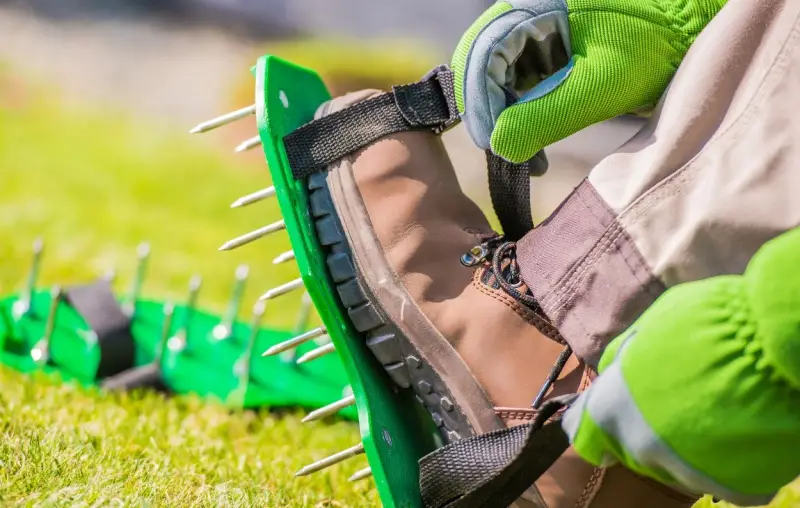
It’s easy to assume that any tool labeled “aerator” will get the job done, which is why many homeowners end up using spike aerators or inexpensive manual tools. These are widely available at big box stores and are often marketed as quick solutions, but they don’t actually relieve compaction effectively. Instead of removing soil, they push it outward, which can make compaction worse below the surface, which is something many DIYers don’t realize until they see little to no improvement afterward.
How to avoid this mistake:
Another mistake that happens frequently is attempting to aerate when the soil is too dry. Many homeowners don’t think about soil moisture beforehand and simply begin aerating when they have the time. Dry, hardened soil resists penetration, which leads to shallow holes and poor plug removal. This often results in uneven aeration and frustration when the equipment doesn’t seem to be working as expected.
How to avoid this mistake:
DIY aeration is often treated as a quick, one-and-done task, especially when using rented equipment that’s only available for a limited time. Homeowners may rush through the process, making a single pass across the lawn and assuming that’s sufficient. In reality, compacted soil, particularly in high-traffic areas, requires more thorough coverage to see meaningful improvement. A single pass usually doesn’t create enough openings for air, water, and nutrients to move effectively through the soil.
How to avoid this mistake:
Many homeowners approach aeration with a one-size-fits-all mindset, assuming every lawn requires the same treatment. This often happens because soil conditions aren’t visible at a glance, making it easy to overlook factors like clay-heavy soil, thatch buildup, or varying levels of compaction. Without taking the time to evaluate these conditions, it’s difficult to know how aggressively to aerate or whether additional steps are needed to support your lawn.
How to avoid this mistake:
After aerating, the lawn is left with small plugs of soil scattered across the surface, which can look messy if you’re not expecting it. Many homeowners assume these plugs should be removed or broken apart right away to improve appearance. This instinct is understandable, especially for those who take pride in a clean-looking lawn, but interfering with the plugs actually reduces the benefits of aeration.
How to avoid this mistake:
Aeration is often viewed as a standalone task, so once the holes are made, many homeowners consider the job complete. This usually happens due to time constraints or a lack of awareness about how important follow-up care is. In reality, aeration creates ideal conditions for improving your lawn, and skipping the next steps means missing out on a major opportunity to enhance growth, thickness, and overall health.
How to avoid this mistake:
Some homeowners, especially those trying to fix persistent lawn issues, assume that frequent aeration will speed up results. This can lead to multiple aeration sessions in a single season without giving the lawn enough time to recover. While aeration is beneficial, overdoing it can disrupt soil structure and put unnecessary stress on your grass, particularly if it’s already struggling.
How to avoid this mistake:
For homeowners looking for a more convenient and consistent solution, professional liquid aeration offers a modern alternative that removes much of the demanding labor. Liquid aeration works by loosening compacted soil at a microscopic level, allowing water, oxygen, and nutrients to move more freely through the soil without tearing up your lawn. There’s no heavy equipment, no soil plugs, and no risk of uneven coverage.
Ready to skip the hassle and get better results? Reach out to Holmes today and ask about our lawn care programs for the Salt Lake City area!
Q: How do I know if my lawn actually needs aeration?
A: If your soil feels hard, water pools on the surface, or your grass struggles to grow evenly, compaction is likely an issue. Heavy foot traffic and clay soils are also strong indicators that aeration would help.
Q: Is core aeration always better than spike aeration?
A: In most cases, yes. Core aeration removes plugs of soil, which relieves compaction more effectively, while spike aeration can sometimes make the problem worse by pushing soil tighter together.
Q: How long does it take to see results after aeration?
A: You may notice improved water absorption right away, but visible lawn improvement typically takes a few weeks, especially if paired with fertilization and overseeding.
Q: Should I mow before or after aerating my lawn?
A: It’s best to mow before aeration. Shorter grass makes it easier for the aerator to reach the soil and improves overall effectiveness.
Q: Can I aerate and overseed at the same time?
A: Yes, and it’s actually one of the best times to overseed. The holes created by aeration provide ideal seed-to-soil contact, helping new grass establish more easily.
Q: What’s the difference between core aeration and liquid aeration?
A: Core aeration physically removes soil plugs, while liquid aeration uses a solution to break up compacted soil from within. Liquid aeration is less invasive and provides more uniform coverage without disrupting the lawn surface.

The Pros & Cons Of DIY Lawn Fertilization
Applying fertilizer to your own lawn could end up doing more harm than good if you don't know what you're doing. Come learn more in this blog post!
Learn MoreIs Your Mulch Attracting Pests?
If you have bugs and pests all over your lawn, your old mulch may be the problem. Come find out how old, decaying mulch can attracts pests to your yard.
Learn MoreShould You Water Your Lawn After Fertilization?
What you do after fertilizing your lawn is crucial to the effectiveness of the application. Come read all about watering-in lawn fertilizers after treatments.
Learn More
Looking for a reliable lawn care company or someone who provides a quality pest control program? Look no further because here at Holmes, we are your lawn and pest experts. You’re happy or it’s free guaranteed.